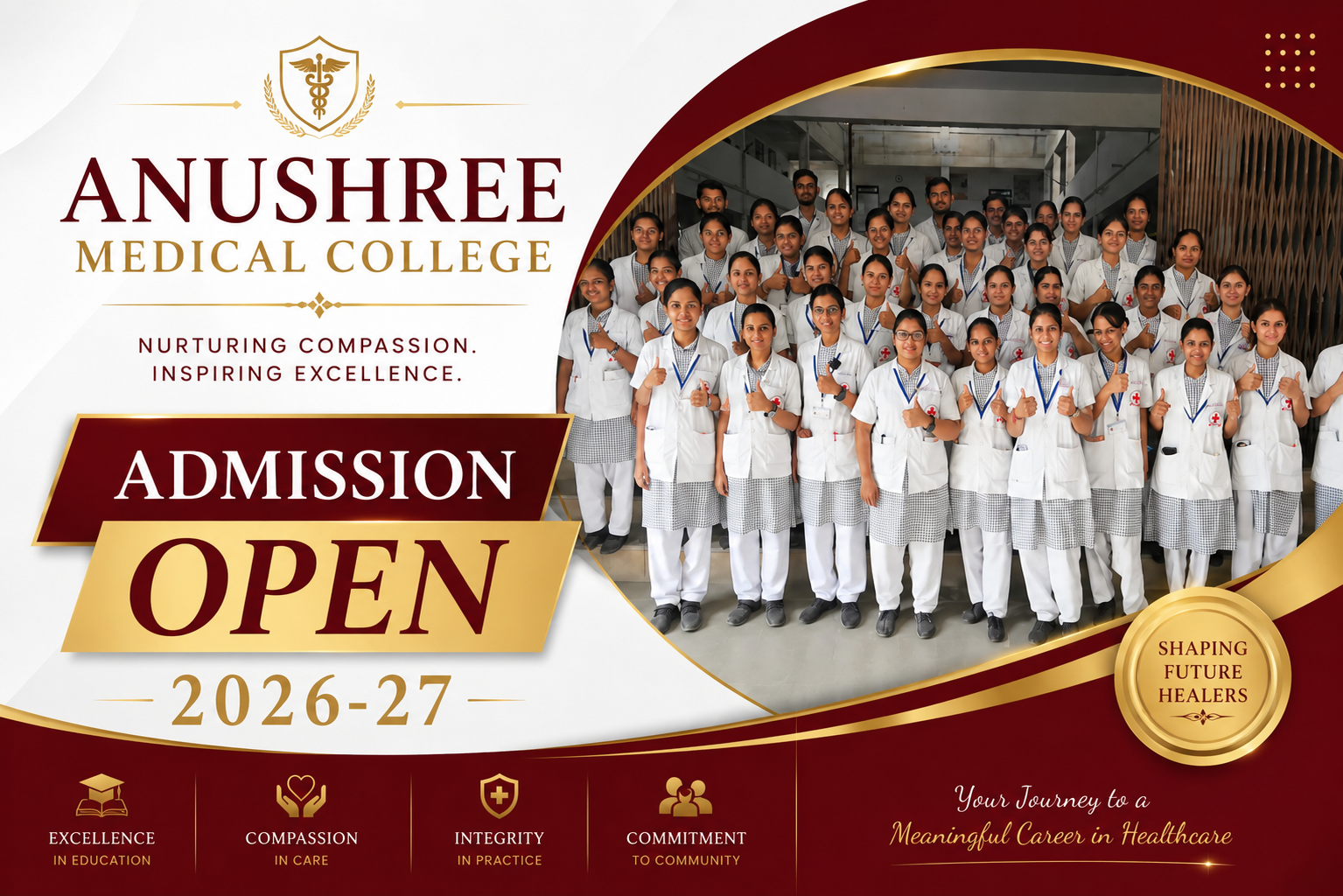
BHMS vs BAMS vs MBBS: Which Course Should You Choose After NEET?

Every year, once NEET UG results are declared, lakhs of students face the same question. With one exam opening the door to multiple medical career paths, how do you decide between MBBS, BAMS, and BHMS? Your NEET score plays a major role, but so do your interests, your budget, and the kind of medical career you actually want to build.
At Anushree Homoeopathic Medical College, we speak with NEET aspirants and their parents every counselling season who are trying to make sense of these choices. This blog breaks down MBBS, BAMS, and BHMS in detail, based on verified information from NTA, the AYUSH Admissions Central Counselling Committee (AACCC), the Medical Counselling Committee (MCC), and official state counselling processes, so you can make a decision with real clarity.
Understanding the Three Courses
MBBS (Bachelor of Medicine and Bachelor of Surgery): MBBS is a 5.5-year program, including 4.5 years of academic study and a mandatory 1-year internship. It remains the most sought-after medical degree in India, preparing students to become licensed allopathic doctors.
BAMS (Bachelor of Ayurvedic Medicine and Surgery): BAMS is also a 5.5-year course, with 4.5 years of academic study followed by a compulsory 1-year internship. It trains students in the traditional Indian system of Ayurvedic medicine, combining classical knowledge with modern clinical training.
BHMS (Bachelor of Homoeopathic Medicine and Surgery): BHMS is a 5.5-year undergraduate degree as well, built around the principles and practice of homoeopathy. Like MBBS and BAMS, it includes a mandatory rotatory internship as part of the course structure.
All three degrees are officially recognised medical qualifications in India, and all three require NEET UG as the mandatory entrance exam.
The Admission Process: How Counselling Actually Works
This is where a lot of confusion happens among students, so let us break it down clearly for each course.
MBBS Admission: After qualifying NEET UG, MBBS admission proceeds through two parallel counselling tracks. The Medical Counselling Committee, under the Directorate General of Health Services, manages 15 percent All India Quota seats in government colleges, along with 100 percent of seats in AIIMS, JIPMER, BHU, AMU, JMI, and other central and deemed universities. The remaining 85 percent of government college seats, along with most private college seats, are managed through respective state counselling authorities. For the 2026-27 academic session, the National Medical Commission has released a total seat matrix of over 1.36 lakh MBBS seats nationwide, combining both government and private colleges.
BAMS Admission: Since 2020, NEET UG has been mandatory for all BAMS admissions across India, with no provision for admission without a valid NEET score. After results, AACCC conducts counselling for the 15 percent All India Quota, covering government, government-aided, and deemed university seats. The remaining 85 percent of seats are filled through respective state AYUSH counselling authorities.
BHMS Admission: BHMS follows the same counselling structure as BAMS. NEET UG qualification is mandatory under National Commission for Homoeopathy and Ministry of AYUSH guidelines. AACCC manages the 15 percent All India Quota counselling, while the remaining 85 percent of seats are allotted through state-level AYUSH counselling bodies. Students are strongly advised to avoid any agent or consultant claiming to offer BHMS admission without NEET, as such claims are not valid under current regulations.
Seat Availability: How Many Options Do You Really Have?
Understanding seat numbers helps put your NEET score into perspective. According to AYUSH admission data for 2026, India offers more than 52,000 AYUSH undergraduate seats combined, with approximately 31,000 BAMS seats and around 13,000 BHMS seats nationwide. MBBS, by comparison, offers a much larger seat matrix of over 1.36 lakh seats, but competition for those seats is also significantly higher, since MBBS remains the most preferred choice among NEET aspirants.
This means that while MBBS has more total seats, it also faces the steepest competition. BAMS and BHMS, while offering fewer seats, tend to have a more accessible cutoff range, making them realistic and rewarding options for a much wider range of NEET scorers.
NEET Cutoff Comparison
Cutoffs vary every year based on exam difficulty, category, and number of applicants, but general trends help illustrate the difference in competition level across these courses.
For MBBS government seats under All India Quota, General category students typically need to aim for 600 or more marks to have a strong chance, while OBC candidates generally target 560 or more, and SC and ST candidates may secure government seats in the 450 to 500 range.
For BAMS and BHMS, the qualifying percentile requirement is lower, generally around the 50th percentile for General and EWS categories and around the 40th percentile for reserved categories. This means students with moderate NEET scores, who may not qualify for MBBS government seats, often have realistic and strong opportunities to secure admission into a good BAMS or BHMS college.
Fees Comparison
Course fees vary widely depending on whether you choose a government or private institution, and this is often a deciding factor for many families.
MBBS fees at government colleges remain relatively low, but private MBBS colleges can range from roughly 80 lakh to over 1 crore for the entire course, making it the most expensive of the three options by a significant margin.
BAMS fees at government colleges are considerably lower, often between 15,000 and 40,000 per year, while private BAMS colleges typically range from 15,000 to 3 lakh per year depending on location and facilities.
BHMS fees follow a similar pattern, generally ranging between 10,000 and 4 lakh per year depending on whether the college is government-run or private, making it one of the more affordable full medical degree options available to NEET qualifiers.
Career Scope After Each Course
After MBBS, graduates become licensed allopathic doctors, with opportunities across hospitals, private practice, specialisation through MD or MS programs, and research or academic roles.
After BAMS, graduates can register and practice as Ayurvedic doctors, pursue MD or MS in Ayurveda, or specialise further through postgraduate diplomas. In recent years, updated regulations have even granted BAMS postgraduates with MS Shalya Tantra qualifications the legal authority to perform a defined set of surgical procedures, reflecting the expanding clinical scope of Ayurvedic medicine. Many BAMS graduates today also find opportunities in India’s rapidly growing wellness and Panchakarma industry.
After BHMS, graduates can work as registered Homoeopathic Practitioners, Medical Officers, Medical Consultants, or Research Associates, with reported salary packages generally ranging between 6 and 10 lakh annually depending on experience and practice setting. Graduates can also pursue MD or MS specialisations in homoeopathy for further career advancement.
So, Which One Should You Choose?
There is no single right answer, since the best choice depends on your NEET score, your financial comfort level, and your genuine interest in a particular field of medicine.
If your NEET score comfortably meets government MBBS cutoffs and allopathic medicine is your primary interest, MBBS remains the most established and widely recognised path.
If you are drawn to traditional medicine systems, want a strong clinical foundation with a full medical degree, and are looking at a more accessible fee structure, both BAMS and BHMS offer genuine, respected, and growing career paths.
Between BAMS and BHMS specifically, the decision often comes down to which system of medicine genuinely interests you. Homoeopathy, taught in the BHMS program, is built on individualised, patient-centered treatment principles and continues to see strong patient demand across India, making it a meaningful and future-ready career choice for students who want to make a real difference in patient care.
Choose the Right College, Not Just the Right Course
Whichever path you choose, the college you select matters just as much as the course itself. Clinical exposure, faculty experience, hospital affiliation, and proper recognition from national bodies all directly affect the quality of your training and your career readiness after graduation.
At Anushree Homoeopathic Medical College, Jabalpur, we are committed to providing quality BHMS education backed by strong clinical training and experienced faculty, helping students build a genuine, respected career in homoeopathic medicine.
Contact Us
📞 Phone: +91-9111000301, 9111000303, 9111000307
📧 Email: anushreehomoeocollege10@gmail.com
📍 Address: 112, Madhotal, Near Samdariya Green City, Jabalpur
🌐 Website: anushreehomoeopathicmedicalcollege.in
If you are a NEET qualifier weighing your options between BHMS, BAMS, and MBBS, reach out to our admission team. We are happy to guide you through eligibility, counselling steps, and what to expect from a career in homoeopathic medicine.
This blog is based on information available from NTA, AACCC, MCC, and official state AYUSH and medical counselling sources as of 2026. NEET cutoffs, seat matrices, and fee structures are revised annually, so candidates should verify the latest figures on the official AACCC (aaccc.gov.in) and MCC (mcc.nic.in) portals before making final decisions.